Basketball Betting Markets: Compare UK Sportsbook Odds
Decoding NBA odds for UK punters
 Available in US
Table of Contents
- Basketball Betting Mechanics vs Standard Sports Markets
- The Five Things Every UK NBA Bettor Should Know
- NBA in the UK: Audience, London Game, NBA Europe
- Is NBA Betting Legal in the UK?
- The Anatomy of an NBA Game and Why It Matters for Bets
- The Three Pillars: Moneyline, Spread, Totals
- Beyond the Basics: Player Props, Parlays, Futures
- Reading the Numbers: American, Decimal, Fractional
- In-Play NBA Betting and Cash Out
- Overtime, Pushes, and Settlement Rules
- Staking Plans and Bankroll Discipline
- UK Safer Gambling: Deposit Limits, FVC and Levy
- Why the 2025 Integrity Scandal Matters to UK Bettors
- A Pre-Bet Routine for the UK NBA Punter
- NBA Betting Glossary
- Frequently Asked Questions
- Where to Go Next
Basketball Betting Mechanics vs Standard Sports Markets
The first NBA bet I ever placed in London was a moneyline on a 4 a.m. Lakers game. I lost. Twelve years and several thousand wagers later, I still meet British punters who treat basketball like a louder cousin of football — and lose money for the same reason I did. They assume the markets work the same way. They don’t.
If you have priced a Premier League match in your head, you already know the broad shape of NBA odds. What changes is the volatility, the ladder of secondary markets, and the way British and American conventions collide on the same betslip. This guide covers the mechanics in plain English, plus the regulatory layer London bookmakers operate under in 2026.
NBA betting has been migrating into the British mainstream. The audience is small but committed — seven percent of UK internet users watch the league, and 77 percent of British basketball fans follow the NBA specifically rather than EuroLeague or domestic ball. Fifty-seven percent of UK NBA viewers are under 35, the youngest profile across six major markets including the United States itself. That skew matters: the NBA-betting product on a typical UK book in 2026 was built for exactly this punter — digital-native, comfortable with second-screen stats, hungry for player props that don’t exist in football.
What follows takes you from “I have heard of moneyline” to reading a Celtics-Bucks game card, placing a sensible stake, and understanding why a line moved 1.5 points before tip-off. We will cover the three market pillars, the three odds formats, the safer-gambling rules that took effect on 31 October 2025 and roll out through 30 June 2026, and the quirks — overtime, late scratches, push refunds — that catch out football-trained bettors most often.
The Five Things Every UK NBA Bettor Should Know
- Three core markets do most of the work: moneyline, point spread and totals. Everything else — props, parlays, futures, alternates — is built on top of those three.
- UK books quote in decimals by default. American (−110) and fractional (10/11) are toggles, not different products. Convert once and the rest is arithmetic.
- Mandatory deposit limits became opt-out at account creation on 31 October 2025, with the full framework rolling out through 30 June 2026. Set yours before your first wager.
- Standard NBA bets include overtime; quarter, half and most player-prop markets do not. Check the settlement rules before clicking confirm.
- Betting on player props for an individual NBA player on his own performance was rewritten after the October 2025 federal indictments. Treat single-player prop limits as live policy, not a back-office formality.
NBA in the UK: Audience, London Game, NBA Europe
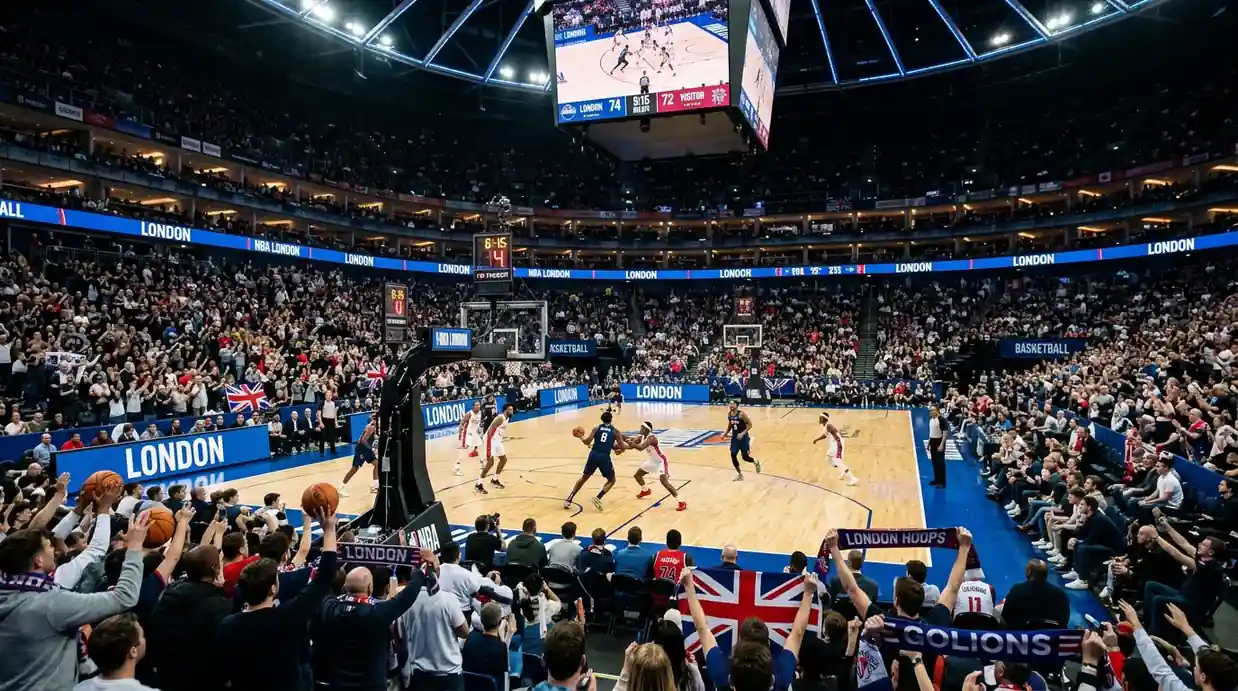
I was at the O2 in January 2026 watching the Knicks line up against the Wizards, and the bloke next to me — a Spurs season-ticket holder, by his scarf — leaned over and asked me, completely seriously, whether the basketball was going to “kick off at half time.” That, for me, is the state of NBA in Britain in one sentence: enormous curiosity, almost no functional knowledge, and a sport that is suddenly everywhere.
EY’s 2025 Sports Engagement Index has basketball climbing seven places in a single year to thirteenth among British adults overall, and sixth among Gen Z viewers aged 18 to 24. Simon Mantell, who runs the EY Sports Industry sector for the UK and Ireland, called the rapid Gen Z growth one of the defining shifts in the British sports landscape, driven by digital content and live experiences. The NBA App alone reported viewing within the UK was up 52 percent year on year, with more than six million EMEA downloads since September 2024.
7%
UK internet audience that watches the NBA — lowest of six surveyed markets, but with the highest concentration of “deep” basketball fans within it.
57%
Share of UK NBA viewers under 35 — the youngest profile across the US, UK, Germany, France, Italy and China.
13th
Basketball’s rank in the EY Sports Engagement Index 2025, up seven places year on year.
52%
UK viewing growth on the NBA App since the start of the 2024–25 season.
The London game on 18 January 2026 was the lab experiment. Entain — the company that owns Ladbrokes, Coral and bwin — published betting handle data uncomfortable for British operators. The Paris game in 2025 produced a 241 percent uplift in NBA betting volume in France. The Berlin game on 16 January 2026 lifted German handle by 274 percent, Italian by 110, Greek by 68. The UK number, by Entain’s own admission, was “more subdued.”
Rene Simanovic, who runs European basketball for Entain, said basketball is establishing itself as a major growth driver across European betting, and the UK’s quieter response highlights a key opportunity. Translation: British punters are not yet betting NBA at the rate the audience size implies, which means products are still under-marketed and markets less efficient than they will be in two years.
NBA Europe launches in October 2027 with sixteen teams. By 31 March 2026, more than 120 investor bids had been submitted, and the London franchise is the most contested. Mark Tatum, the NBA’s deputy commissioner, told a TalkSport press briefing in October 2025 that there are no top-tier teams in the UK and that there has to be, because the demand and the size of the market mean the league has to service those fans.
Is NBA Betting Legal in the UK?
Yes — and the version of “yes” matters. The UK is the largest legal sports betting market in Europe, and gross gambling yield across the regulated industry hit £15.6 billion in the most recent reporting cycle, the highest figure ever recorded. Andrew Rhodes, who has run the UK Gambling Commission since 2021, put participation at 48 percent of the adult population in his BGC AGM speech on 27 February 2025. NBA betting is not a grey-zone product. It is a fully licensed, taxed, audited corner of a £7.8 billion remote casino, betting and bingo sector that grew 13.1 percent year on year in the most recent fiscal year.
What “legal” actually means in practice. Any operator offering NBA markets to a UK resident must hold a remote betting licence from the UK Gambling Commission. That licence places it inside a specific compliance perimeter: anti-money-laundering checks, financial vulnerability monitoring, the BGC voluntary code where applicable, GamStop participation, and direct accountability to the Commission for marketing, settlement and integrity. If a site is taking your NBA bet without that licence, you have no Financial Ombudsman pathway, no GamStop coverage, and no UKGC dispute resolution.
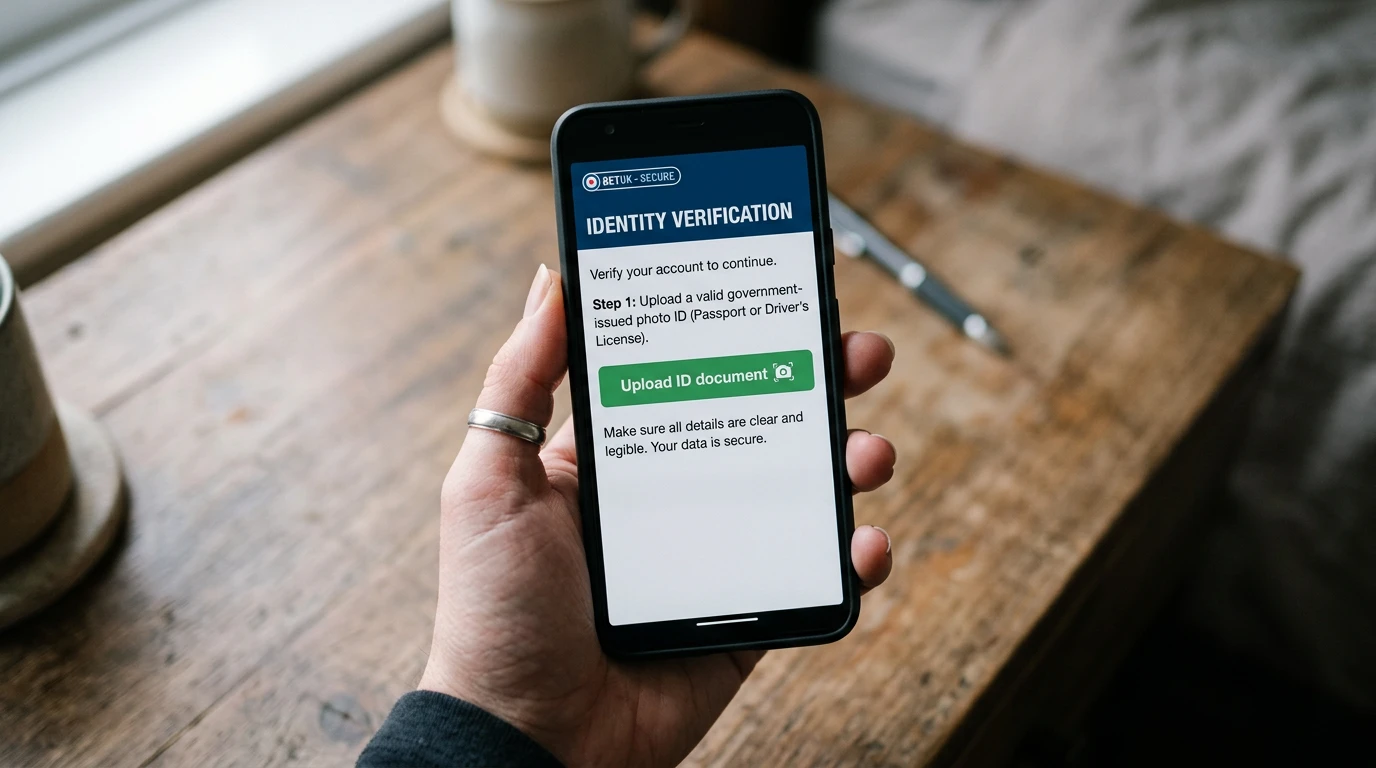
The legal age is 18 across the UK for all sports betting products, with no NBA-specific carve-out. Online verification is mandatory before any deposit, and bookmakers have been tightening identity checks meaningfully — the Commission carried out 9,700 compliance actions in 2024–25 alone, more than double the 4,200 it logged the year before. If your verification feels intrusive, that is the regulator working as designed.
One piece worth flagging because it confuses football bettors crossing into basketball: there is no separate legal framework for “American sports” in the UK. NBA, NFL, MLB and NHL all sit under the same Gambling Act 2005 / 2014 framework as horse racing and football. The product looks different — different markets, different odds defaults, different scoring rhythms — but the regulator is the same, the licence is the same, and the safer-gambling tools are identical.
The Anatomy of an NBA Game and Why It Matters for Bets
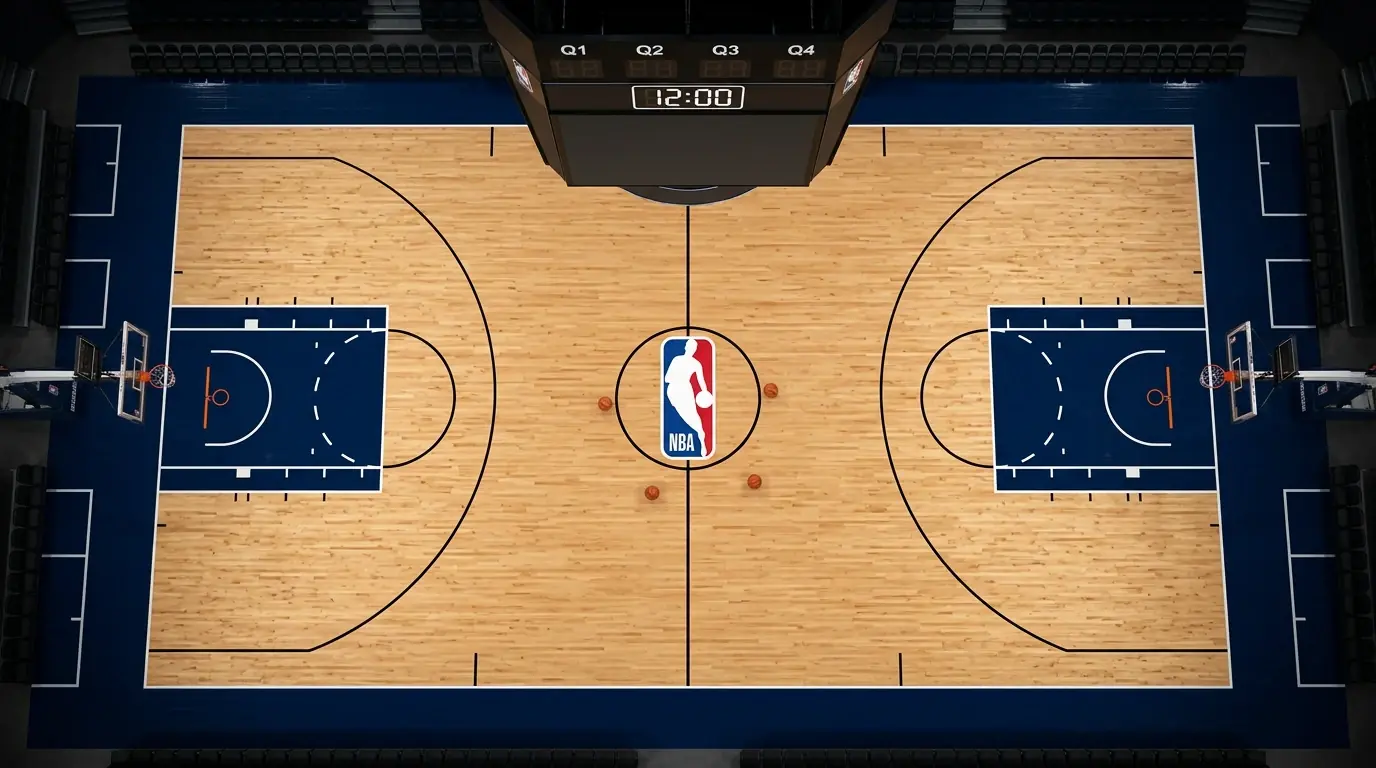
I once watched a man in a Camden pub place a “first half” bet on a Lakers game, then storm out at the end of the third quarter convinced he had been robbed. He had not been robbed. He had bet on something that ended at the buzzer of the second quarter, twenty-four minutes of game time before he thought it had. Football habits are hard to break. Basketball is not divided into halves of equal weight; it is divided into quarters, and that single fact reshapes about a third of the markets you will see on a betslip.
An NBA game is four quarters of twelve minutes each — forty-eight regulation minutes. Stops, fouls, free throws and reviews mean a typical broadcast clocks in around two and a half hours. Halftime sits between Q2 and Q3 and runs about fifteen minutes. The clock stops on whistles, which is why a “two-minute warning” of game time often becomes ten minutes of real time and a parade of substitutions.
Regulation: 48 minutes. Four 12-minute quarters. The score at the end of the fourth determines standard moneyline, spread and totals — including any overtime that follows.
Halftime split. The “first half” is Q1 and Q2 combined; the “second half” is Q3 and Q4. First-half markets settle at the buzzer of Q2.
Quarter markets. Each quarter has its own moneyline, spread and total. Settled on that quarter’s score alone — overtime is excluded.
Overtime: 5 minutes per period. Triggered if scores are level at the end of regulation. Multiple overtimes are possible until a winner emerges.
Pace — The estimated number of possessions a team uses per 48 minutes. A high-pace team like the Indiana Pacers will produce dramatically different totals lines than a low-pace, half-court team such as Memphis, even at similar offensive ratings.
The 24-second shot clock is the structural feature you should internalise. Every offensive possession must end with a shot that touches the rim within 24 seconds. That is why an NBA game produces around 100 possessions per team — more possessions, more variance, more scoring, and the reason NBA totals routinely sit in the 220–240 range while a Premier League over/under sits at 2.5. Possession structure also explains why momentum swings show up in betting markets so visibly. A 12-point lead with eight minutes left is closer to a 70-percent win probability — comfortable, but not safe. Live cash-out values reflect that volatility, and we will revisit it when we get to in-play wagering.
The Three Pillars: Moneyline, Spread, Totals

Six years ago I argued for half an hour in a Liverpool pub about whether the moneyline on a Brooklyn-Boston game was a “bad bet.” It was not. I just had not yet internalised that the moneyline, the spread and the total are not three different opinions about a game — they are three projections of the same opinion. See them as a triangle and the landscape simplifies.
Across the regulated US market, basketball accounts for around 32 percent of all sports-betting handle, with the NBA generating the lion’s share. That tells you the market is liquid and tightly priced. The lines you see on a UK book at noon for a 1 a.m. tip-off have been pressure-tested by sharp money. Edge is not free.
| Market | What you are picking | Typical odds shape | Where the volatility lives |
|---|---|---|---|
| Moneyline | The outright winner, overtime included | Heavy favourites at short prices, e.g. 1.20 on a strong home side | Underdog upside is large but rare |
| Point spread | Margin of victory adjusted by a handicap, overtime included | Both sides priced near 1.91 (−110 American) | Knife edge — half a point can flip the result |
| Total (over/under) | Combined points scored, overtime included | Both sides near 1.91, totals set in the 215–240 range | Pace, defence and shooting variance stack into one number |
The moneyline is cleanest for beginners — no handicap to misread. If the Lakers are 1.40 to beat the Pelicans, a £10 stake returns £14. The trade-off is asymmetry: heavy favourites at 1.20 require a strike rate above 83 percent just to break even. I have lost more money to “obvious” 1.20 favourites in February than to any other single mistake.
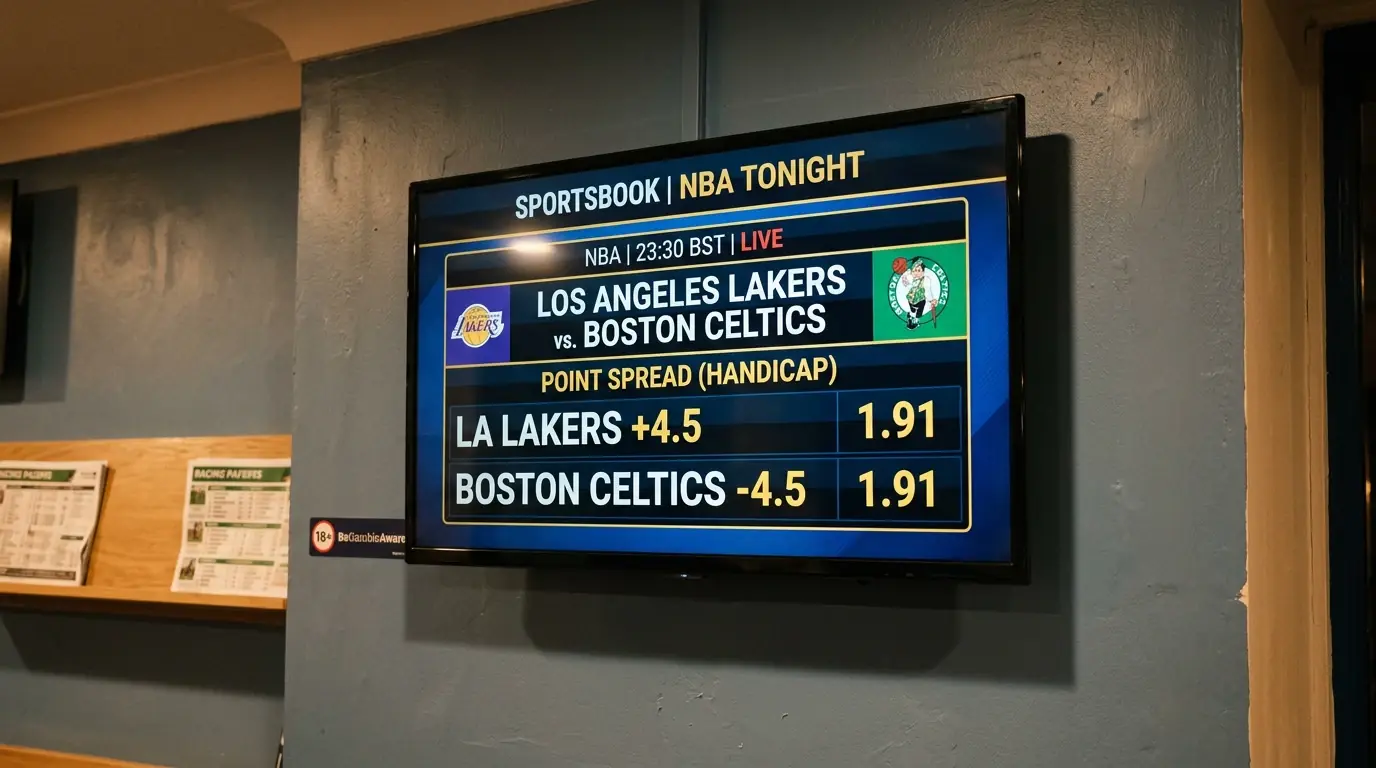
The spread flattens that asymmetry. Instead of pricing the Lakers at 1.40, the bookmaker says “the Lakers will win by more than 6.5 points” and prices both sides at roughly 1.91. The half-point is deliberate — basketball never lands on a fractional total, so a half-point spread eliminates ties.
A £20 spread bet, worked end to end
Bet: Lakers −6.5 at 1.91. Stake: £20. Final: Lakers 118, Pelicans 109. Lakers cover by 9.
Return: £20 × 1.91 = £38.20. Profit: £18.20. The 1.91 price implies a break-even rate of 52.4 percent.
The total is the third leg and the most under-appreciated for UK punters arriving from football. Where Premier League over/under markets live in a tight 2.5–3.5 range, NBA totals routinely sit between 215 and 240. That wide range is the bookmaker pricing pace and defensive intensity into a single number. For the full taxonomy — alternate spreads, team totals, derivatives and niche corners — see NBA betting markets explained. One thing to keep in mind: these three markets are mathematically linked. When they move out of sync, that is information.
Beyond the Basics: Player Props, Parlays, Futures
Player props are why most sharp punters I know spend more time on NBA than on football. They used to be priced by junior traders with one eye on the screen and the other on a TV. That gap has closed dramatically since 2024, and it closed entirely in October 2025 when the Terry Rozier and Chauncey Billups federal indictments forced a wholesale rewrite of single-player prop policy.
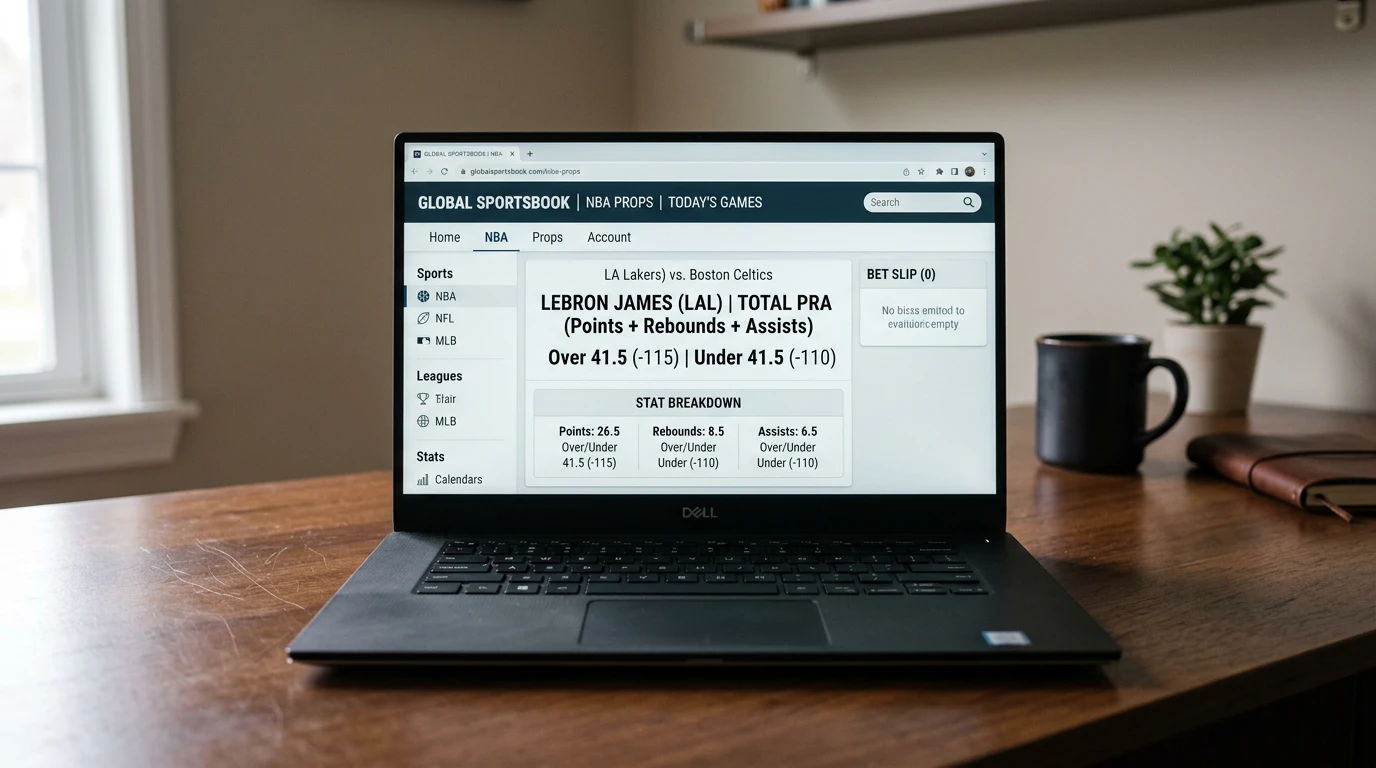
The mechanics have not changed. A player prop is a wager on the statistical performance of one player in a single game. Will LeBron James score over 24.5 points? A binary market, priced near 1.91 on either side, settled on the official NBA box score after the final buzzer.
Points
The most liquid prop. Lines for stars sit between 22.5 and 30.5; role players between 8.5 and 16.5.
Rebounds
Centres and power forwards drive most action. Lines typically 7.5 to 13.5. Sensitive to opponent pace and three-point volume.
Assists
Point-guard market. Lines for elite playmakers sit at 8.5 to 11.5. Tightly correlated with team field-goal percentage.
Threes made
Specialist market for high-volume shooters. Lines from 1.5 to 5.5. The most variance-heavy single-stat prop.
PRA — Points + Rebounds + Assists, summed for one player in one game. The most popular composite prop. A line of 38.5 PRA on a star wing is roughly 24 points, 7 rebounds and 7.5 assists.
For the deep how-to on prop selection and the new single-player prop policy, see NBA player props betting. The summary: in the first half of the 2025–26 playoffs, more than 95 percent of public handle landed on the over for at least one major prop market — Game 2 of Philadelphia versus New York with Ov 215.5 was the most extreme example I tracked — and that lopsided distribution is exactly the pattern that creates closing-line value on under bets.
Parlays — accumulators in British, same-game parlays known as SGPs — combine multiple selections where every leg must win. Two legs at 1.91 return roughly 3.65; three legs return about 7.0. Each leg compounds the bookmaker’s hold, so a four-leg parlay carries an effective vig around 8 percent compared with 4.5 percent on a single bet. The headline returns are seductive. The expected value is almost always worse.
Futures sit at the opposite end of the time horizon. Several books trimmed maximum stake limits on individual-player markets after the October 2025 indictments. Season win totals are the cleanest futures market for value.
Markets are only half the story. The price you see depends on which odds format your bookmaker displays, and that is where the next section starts.
Reading the Numbers: American, Decimal, Fractional
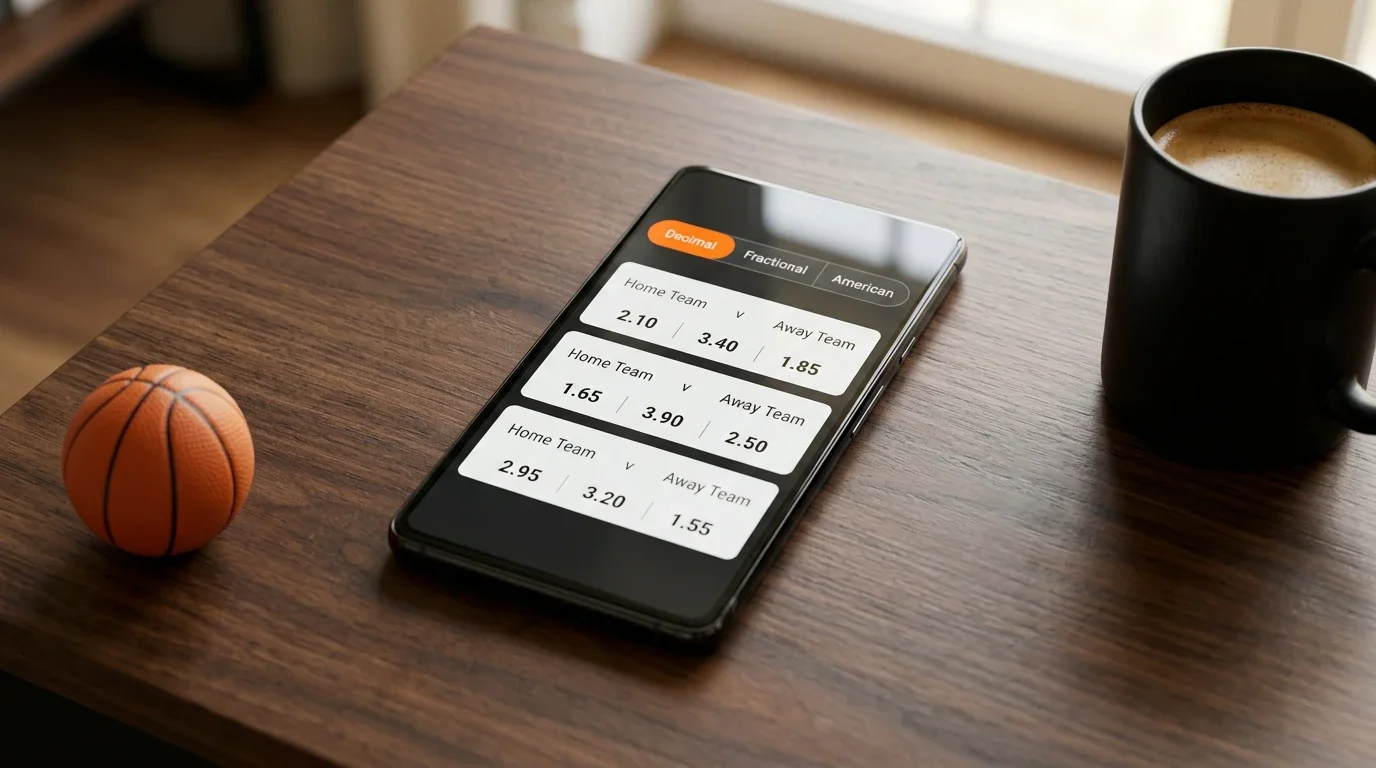
The first time I logged into a US-facing book and saw “−110” on a Lakers spread, I genuinely thought it was a typo. Twelve years later, I now mentally toggle between three odds formats inside a sentence — and so will you. UK books in 2026 have largely accepted that NBA punters arrive with American TV in their heads. Most British operators now offer a one-click switch between decimal, fractional and American odds for every NBA market.
The three formats describe the same probability. Decimal shows total return per unit staked, fractional shows profit relative to stake, American shows what £100 either wins (positive prices) or stakes (negative prices). The conversion is simple arithmetic.
| Decimal | Fractional | American | Implied probability |
|---|---|---|---|
| 1.91 | 10/11 | −110 | 52.4% |
| 2.00 | 1/1 (evens) | +100 | 50.0% |
| 2.50 | 3/2 | +150 | 40.0% |
| 1.40 | 2/5 | −250 | 71.4% |
| 4.50 | 7/2 | +350 | 22.2% |
Decimal is the British default and what I recommend keeping your account set to, for one reason: it makes parlay maths transparent. A four-leg parlay at 1.91, 2.10, 1.65 and 1.75 multiplies cleanly to a total return multiplier of 11.58. With decimals, it is GCSE arithmetic.
Fractional is the format you grew up with if you bet on horses or football in a high-street shop. The fraction is profit-to-stake. A 10/11 quote means you stake £11 to win £10, returning £21. The mental conversion to decimal is fraction-plus-one: 10/11 = 0.909 + 1 = 1.91.
American odds are the format you will see on every NBA TV graphic. The convention: a negative number is the amount you stake to win 100 units; a positive number is the amount you win on a 100-unit stake. So −110 means stake £110 to win £100. +150 means stake £100 to win £150. The reason “−110” became iconic is that it is the shorthand for the standard 4.5 percent vig on a balanced two-way market.
Implied probability is the concept that ties this together. Every odds quote has an implied probability — the win rate at which the bet is exactly break-even. For decimal odds, the formula is 1 / decimal × 100. For 1.91, that is 52.4 percent. Lakers −5.5 at 1.91 implies 52.4 percent. Pelicans +5.5 at 1.91 implies 52.4 percent. Together they sum to 104.8 percent — the extra 4.8 percent is the bookmaker’s overround. Lower-overround books are sharper books, and the difference between a 4.5 percent vig and a 7 percent vig over a year of NBA betting is the difference between a serious hobby and an expensive one. The deep dive on overround calculation, line shopping and probability conversion sits in reading NBA odds across formats.
In-Play NBA Betting and Cash Out
Real-event betting in the UK grew 16 percent year on year by GGY in the most recent reporting cycle, by far the fastest-growing slice of the British wagering market. NBA is the engine room of that growth on the basketball side. The reason is structural: a 48-minute game with 100-plus possessions and a 24-second shot clock generates roughly one priceable event every 14 seconds — about 200 times the live-market intensity of a Premier League match.
How an in-play NBA market actually behaves. Live odds update in near-real time, but the model the bookmaker uses is a hybrid of pre-game projections, scoreboard state, time remaining, possession indicator, foul totals and player on/off floor. Markets suspend briefly on key events — a made three, a timeout, an injury — and reopen with revised numbers. Suspensions are not bugs; they are the trader pausing the model to let the situation resolve.
The clearest signal in NBA in-play is line movement triggered by foul trouble. When a star picks up a third foul in the second quarter, the live moneyline on his team typically moves three to five percent against him within thirty seconds, because the model now projects fewer of his minutes in the third. If you watch closely, you can see the trader’s hand: timeouts and substitutions ripple through the price within seconds.
Cash out is the live product most British punters use without fully understanding the maths. The bookmaker offers to settle your live bet early at a price reflecting the current implied win probability, minus a margin. If you took Lakers −5.5 pre-game at 1.91 and they are up 12 with eight minutes to play, the cash-out value will be perhaps 1.65 of your stake — below the full payout if the bet wins, but locked in regardless.
The mistake I see most often is cashing out for emotional reasons rather than mathematical ones. Cash out has expected value when you genuinely believe the live model is overpricing your team’s win probability. Cashing out because you are nervous is a trade with yourself, not with the market. For cash-out timing, momentum-based pricing and line-movement reading in depth, see NBA in-play and live betting.
Overtime, Pushes, and Settlement Rules
I have lost actual money to overtime rules. The single most expensive misunderstanding among UK punters new to the NBA is treating overtime as if it works like extra time in a cup tie. It does not. Overtime is folded directly into some markets and excluded entirely from others, and the difference has cost me, conservatively, a thousand pounds over twelve years.
The rule in one sentence: standard moneyline, spread and total markets include overtime. Quarter markets, half markets and most player-prop markets exclude it. The safer mental model: anything specified by a time window shorter than the full game ignores overtime; anything that asks “who wins” or “how many points total” includes it.
A moneyline on the favourite settles on whoever wins after all overtime periods. A spread of −5.5 settles on the final scoreline including overtime. A total of 224.5 settles on the combined score including overtime, which is why “going over” is dramatically more likely in any OT game: every five-minute period typically adds 22 to 28 points. By contrast, a fourth-quarter spread settles on Q4 alone — overtime points do not count. A first-half total settles at the buzzer of Q2. Player-prop overtime treatment varies by operator, and the only safe answer is to read your bookmaker’s terms once and remember the rule.
Do
- Read the settlement rules for player props on your specific bookmaker’s terms — overtime treatment varies by book.
- Treat any overtime-bound game as a likely “over” on the full-game total, given the extra possessions a five-minute period adds.
- Remember that quarter and half markets always exclude overtime — a profit on a Q4 spread cannot be lost in OT.
Don’t
- Don’t assume player-prop overtime treatment matches the operator next door — it does not, consistently.
- Don’t bet a fourth-quarter total expecting a tied score at the buzzer to push the bet into overtime — Q4 settles at 0:00 of regulation regardless.
- Don’t confuse a “push” with an overtime trigger. A spread landing exactly on the handicap pushes; a moneyline tied at the end of regulation goes to OT.
One last subtlety. A push refunds your stake at decimal odds of 1.00 — wager back, no profit, no loss. Pushes are rare on standard NBA spreads because almost all are quoted with a half-point. They are more common on integer alternate spreads (e.g. Lakers −7) and on round-number totals.
Staking Plans and Bankroll Discipline
The most important sentence I will write in this guide: the NBA betting market is professional, and you are competing against models that price 1,230 regular-season games a year using closing-line value as their feedback loop. You are not going to outwit them on stock-picking. You are going to outwit them, if at all, on staking discipline, market selection and patience.
During Safer Gambling Week 2024 in the UK, more than 1.5 million unique British accounts used safer-gambling tools — a 22 percent jump on the previous year — and 47 percent of users setting deposit limits were doing so for the first time. The British betting public, in aggregate, is starting to internalise that bankroll discipline is the entire mechanism by which serious bettors stay in the game long enough to be right.
Bankroll and staking — the seven-step check
- Set a fixed monthly bankroll. Money you can afford to lose entirely without affecting rent, food or pension.
- Stake a flat percentage of bankroll per bet — typically 1 to 3 percent. Never adjust upward to “make back” losses.
- Track every wager. Date, market, odds, stake, result.
- Review monthly. Calculate your closing-line value, not just your win rate.
- Cap your daily loss limit before you ever sit down for a slate of games.
- Avoid parlays unless they are correlated and priced advantageously.
- Take a deliberate break of at least one full day per week with no wagers placed.
The mathematics are simple: a flat-stake bettor at 53 percent win rate on −110 odds ends a year of 500 wagers in profit. The same bettor chasing losses with variable stake sizes ends the year flat or down even at the same hit rate, because variance hits hardest when stakes are largest. Closing-line value — abbreviated CLV — is the single best long-term performance metric I know of. It compares the price you got at the moment you placed your bet against the closing price the market settled on before tip-off. If you consistently take prices that improve before the game starts, you are beating the market in the only sense that matters statistically.
Bet flat percentages, track everything, and judge yourself by closing-line value rather than weekly win/loss. The discipline is unglamorous and entirely the difference between losing slowly and breaking even — or, occasionally, winning.
UK Safer Gambling: Deposit Limits, FVC and Levy

If you opened a UK bookmaker account before October 2025 and one in 2026, you have lived through the most significant rewrite of British player-protection rules in two decades. The mechanics of an NBA wager have not changed. The mechanics of how the bookmaker is required to know you, monitor you and intervene with you have changed entirely.
The UK Gambling Commission’s mandatory deposit-limit rules took effect on 31 October 2025. Every UK-licensed operator must offer a deposit limit option at account creation as a default opt-out — meaning you actively decline setting one, rather than actively choose to set one. The full framework, including monthly and lifetime options and instant downward adjustments, completes its rollout on 30 June 2026. The shift from opt-in to opt-out is the most consequential change, because behavioural research shows defaults dominate willpower.
The financial vulnerability check threshold dropped from £500 to £150 net deposits over a rolling thirty days in February 2025. That figure is now the trigger at which a UK bookmaker performs a “light-touch” check on your financial profile, drawing on credit reference data without affecting your credit score. Most NBA-only punters will never trigger an FVC.
The BGC Voluntary Code thresholds. Financial risk reviews trigger at £5,000 net deposits in 30 days for adults and £2,500 for 18 to 24-year-olds. Full documentary checks — bank statements, payslips, source-of-funds — kick in above £25,000 in annual deposits. The BGC represents over 90 percent of UK retail and online operators, so in practice these thresholds apply to nearly every regulated bookmaker.
The Statutory Gambling Levy came into force on 6 April 2025. It is a percentage of operator GGY ringfenced for problem-gambling research, prevention and treatment — paid by the operator, not deducted from your stake. GamStop is the national self-exclusion scheme; any UK punter can register at no cost and exclude from all UK-licensed sites for six months, one year or five years. An offshore site offering NBA markets without GamStop integration is, by definition, not UK-licensed.
The five practical numbers: deposit-limit defaults from 31 October 2025, full framework by 30 June 2026, FVC trigger at £150 over 30 days, BGC affordability threshold at £5,000 over 30 days (£2,500 for under-25s), full source-of-funds review at £25,000 annual. Full breakdown in UK regulation for NBA bettors.
One reassuring data point: the rate of problem gambling in the UK adult population sits at roughly 0.2 percent, one of the lowest in Europe. Tim Miller of the UK Gambling Commission said in November 2025 that the youth-adapted problem gambling screen had moved from 1.5 percent to 1.2 percent — a statistically stable figure rather than a worsening trend.
Why the 2025 Integrity Scandal Matters to UK Bettors
On 23 October 2025, federal prosecutors in the Eastern District of New York announced indictments against more than thirty individuals — including the active NBA player Terry Rozier and head coach Chauncey Billups — on charges related to illegal sports betting and game-fixing. Two days later, Commissioner Adam Silver told NBC’s Cassidy Hubbarth he was deeply disturbed by the news, that nothing was more important than competitive integrity, and that the situation had left him with a pit in his stomach. The reason this matters to a UK punter, even one who has never bet a player prop, is that the entire mechanism of how single-player markets are priced and offered changed within weeks.
The mechanics of what allegedly happened are simple and chilling. Schemes involved players or their associates manipulating their own statistical performance — minutes, fouls, deliberate misses — to settle prop bets placed on insider information. The vulnerability was the prop market itself: a single player can determine the outcome of his own points-rebounds-assists prop in a way no individual player can determine a team moneyline. The market structure created the temptation. The federal investigation cracked it open.
Silver returned to the theme at his pre-NBA Cup press conference on 16 December 2025, telling reporters bluntly that “fans definitely care.” He warned that if the league were not perceived as honest, fans would walk away over time.
Andrew Rhodes told the UK Gambling Commission’s CEO Briefing on 6 November 2025 that the Commission’s last two annual reports show a 300 percent year-on-year increase in criminal cases taken forward — cases about betting integrity, cheating, and illegal gambling. The British regulator is operating in lockstep with the American conversation.
For you in 2026: single-player prop markets are now subject to tighter maximum-stake limits across most regulated UK books than they were eighteen months ago. Some operators have removed certain individual-player props entirely for designated lower-profile players whose limited sample sizes make manipulation harder to detect. The illegal market context provides the scale: the American Gaming Association estimates the size of the illegal US sports-betting market at approximately $700 billion in handle per year — a 22 percent increase since 2022.
The takeaway is not that you should stop betting NBA props. It is that you should treat single-player prop limits and book policy as live information, not background noise. If a book reduces your max stake on a specific player without explanation, that is the integrity model speaking.
A Pre-Bet Routine for the UK NBA Punter
Twelve years of NBA betting has taught me one thing more than anything else: the difference between a good night and a bad night is rarely the bets I picked. It is the routine I followed before I picked them. The punters I know who have stayed in profit over a decade share one habit — they all run a pre-bet checklist that takes between two and five minutes per slate. The ones who blew their bankrolls in eighteen months all skipped exactly the same five steps.
The pre-bet checklist for the UK NBA punter
- Check the official NBA injury report. Filed twice — at 5 p.m. and again 30 minutes before tip-off.
- Check the starting line-up confirmation. Don’t bet props on a player listed “questionable” until the line-up is confirmed.
- Compare the line at three different UK-licensed bookmakers. Half a point on a spread is meaningful.
- Check the back-to-back schedule. Teams playing the second of a back-to-back have measurably worse pace.
- Confirm your stake is your standard 1–3 percent of bankroll. No exceptions for “lock” picks.
- Set or confirm your daily loss cap before placing the first bet.
- Walk away if any of the above checks felt rushed. The market will be there tomorrow.
Do
- Treat injury news within 90 minutes of tip-off as the highest-information event of the day.
- Use a deposit limit, even if it is generous. The act of setting one shifts your relationship with the bet.
- Read the official NBA injury report at source. Twitter aggregators get it wrong an unsettling percentage of the time.
Don’t
- Don’t chase a losing day with a “get-back” parlay. The expected value math is brutal and the variance worse.
- Don’t bet on games during the pre-tip-off shoot-around if a star player is listed questionable.
- Don’t ignore back-to-back schedules. The second night of a back-to-back is the most reliable signal in the entire NBA betting calendar.
One last note: keep records, even when you do not feel like keeping records. A spreadsheet with date, market, odds, stake and result, updated within an hour of each settlement, is the single most powerful tool a UK NBA bettor can build. It tells you, after a year, where your edge actually is — and where you thought it was but was not.
NBA Betting Glossary
Most of the confusion in NBA betting is vocabulary, not maths. Here is a working glossary — not exhaustive, but the terms you will actually encounter on a UK betslip in 2026.
ATS — Against The Spread
A team’s record evaluated against the point spread rather than the actual outcome. A team can win 50-32 outright but go 36-46 ATS — and the ATS record is the one that matters to spread bettors.
Chalk
The favourite. Taking heavy chalk over a long stretch is one of the most consistent ways to slowly bleed bankroll.
Cover
To win a spread bet by beating the handicap. Lakers −5.5 covers if they win by six or more.
Closing line
The final price on a market just before tip-off. The sharpest version of the market because it has absorbed the most information.
CLV — Closing Line Value
The difference between the price you got and the closing line. Positive CLV across hundreds of bets is the best evidence that your process beats the market.
Hook
The half-point on a spread. “Lakers −7.5” has a hook; “Lakers −7” does not.
Juice / Vig
The bookmaker’s built-in margin. On a standard −110/−110 NBA market, the vig is roughly 4.5 percent of total handle.
Pace
Possessions per 48 minutes. Pace differential between two teams is one of the strongest predictors of game total.
Parlay / Accumulator
A multi-leg bet where every leg must win. Two-leg parlays compound the vig once; four-leg parlays compound it three times.
PRA
Points + Rebounds + Assists, summed for a single player in one game. The most popular composite stat for player-prop pricing.
Push
A tied bet that refunds the stake. Rare on standard NBA spreads because half-point lines exclude exact ties.
Sharp money
Wagers placed by professional or semi-professional bettors. Sharp money tends to move lines against the public consensus.
SGP — Same-Game Parlay
A parlay where every leg comes from the same game. Correlations between legs are priced in by the bookmaker, generally to your disadvantage.
Total / Over-Under
The combined points scored by both teams. Standard NBA totals sit between 215 and 240; playoff totals trend lower.
Underdog / Dog
The team expected to lose. Dogs are priced at decimals above 2.00 on the moneyline and at positive American numbers like +180.
Frequently Asked Questions
The questions I am asked most often by UK punters new to the NBA cluster around six themes.
Is NBA betting legal in the UK?
Yes, fully — provided you bet with an operator licensed by the UK Gambling Commission. Every UKGC-licensed bookmaker can lawfully offer NBA markets to British residents aged 18 or over, under the same Gambling Act framework that governs football. There is no NBA-specific carve-out, and the mandatory deposit-limit framework that began rolling out on 31 October 2025 applies identically to NBA and Premier League wagers.
Do NBA bets include overtime?
Standard moneyline, spread and total markets settle on the final score including any overtime. Quarter and half markets do not — they settle at the buzzer of the relevant period. Player-prop overtime treatment varies by bookmaker. Check your specific bookmaker’s settlement rules once when you open the account.
How do I read NBA odds — American versus decimal versus fractional?
UK bookmakers default to decimal, which shows total return per unit staked. £10 at 1.91 returns £19.10. American odds are the US TV format: −110 means stake $110 to win $100, equivalent to 1.91. Fractional 10/11 is the same price as profit-to-stake. Most British bookmakers offer a one-click toggle between all three.
What is the difference between moneyline, spread and totals?
Moneyline is the simplest: pick the team that wins outright, overtime included. Spreads add a points handicap to neutralise the favourite — Lakers −6.5 wins only if they win by seven or more. Totals (over/under) ask whether the combined points scored will be above or below a set number, typically 215 to 240. The three markets are mathematically linked — all derive from the same projection.
What are NBA player props and how do they work?
A player prop is a wager on the statistical performance of one player in one game. Categories include points, rebounds, assists, threes made, and PRA. “LeBron James over 24.5 points” is settled on his official box-score points at the final buzzer. Both sides are typically priced near 1.91. Player-prop limits and policy were significantly rewritten across the industry following the federal indictments of 23 October 2025.
Can I bet on NBA games live in-play in the UK?
Yes, every UKGC-licensed bookmaker that offers NBA markets also offers in-play wagering. Live markets update in near-real time and include moneyline, spread, total, quarter spreads and player-prop refreshes. UK real-event betting GGY grew 16 percent year on year in the most recent reporting cycle. Cash-out is available on most live wagers — the bookmaker offers to settle your bet early at a price reflecting the current implied probability.
Where to Go Next
You now have the full mechanical picture. The next step is the depth on whichever piece of that picture matters most to you.
If you want to understand the universe of NBA markets — alternate spreads, team totals, derivative wagers — the dedicated piece on NBA betting markets is your next stop. If you came for the odds-format puzzle and want to drill into vig, overround calculation and line shopping, the odds-format breakdown is built for that. Player-prop selection in 2026 is its own specialist area after the October 2025 policy rewrites. The UK regulation deep-dive walks through every threshold I touched on briefly. And if live betting is where you spend most of your evenings, the in-play guide covers cash-out timing and momentum-based pricing in the depth this guide could not.
The mechanics in this guide are not going to change. NBA basketball is forty-eight minutes of regulation, decimal odds defaulting on every UK book, mandatory deposit limits, GamStop, integrity rules tightening. What will change is the league itself — NBA Europe lands in October 2027, a London franchise looks increasingly likely, and the British NBA betting audience that is “more subdued” today will be a primary product category by the end of the decade. The work you do learning the mechanics now is the work that will pay off when your local team is being priced on your local book.
Created by the ”how Does nba Betting Work” editorial team.